Saw Prince of Persia the other day. Some story about a dude convincing people to invade a state after said dude claimed that state had dangerous and threatening weapons, so that the dude can take over that state and drill down the ground to access an immense source of power.
Movie was not so bad.
I learnt that having a movie ticket thrown in your face, then having the ticket-thrower come back 10 mins later, tail between legs, looking for the thrown ticket so he could ask for a refund, leaves you with a pretty satisfying feeling.
Thursday, June 17, 2010

Saturday, June 12, 2010
How bad is IP?
Mike Masnick over at Techdirt has an article discussing David Koepsell's argument that intellectual property is unethical.
The question is the following one:
Thinking cases where individuals or corporations have abused of IP law, my initial reaction was that the argument made sense. Back when I took IP Law, the prof gave a few reasons why there should be IP protection, none of which made any sense. The main argument was that protection leads to more incentive for creation. If this premise is shown to be wrong, then wouldn't it make sense to say that the entire concept of intellectual property is wrong too?
The question is the following one:
[I]f it's true that by doing away with the idea of intellectual property, you create greater opportunities for everyone, could you make the argument that intellectual property laws themselves are immoral or unethical in that they are actually what makes everyone worse off?
Thinking cases where individuals or corporations have abused of IP law, my initial reaction was that the argument made sense. Back when I took IP Law, the prof gave a few reasons why there should be IP protection, none of which made any sense. The main argument was that protection leads to more incentive for creation. If this premise is shown to be wrong, then wouldn't it make sense to say that the entire concept of intellectual property is wrong too?
Saturday, May 08, 2010
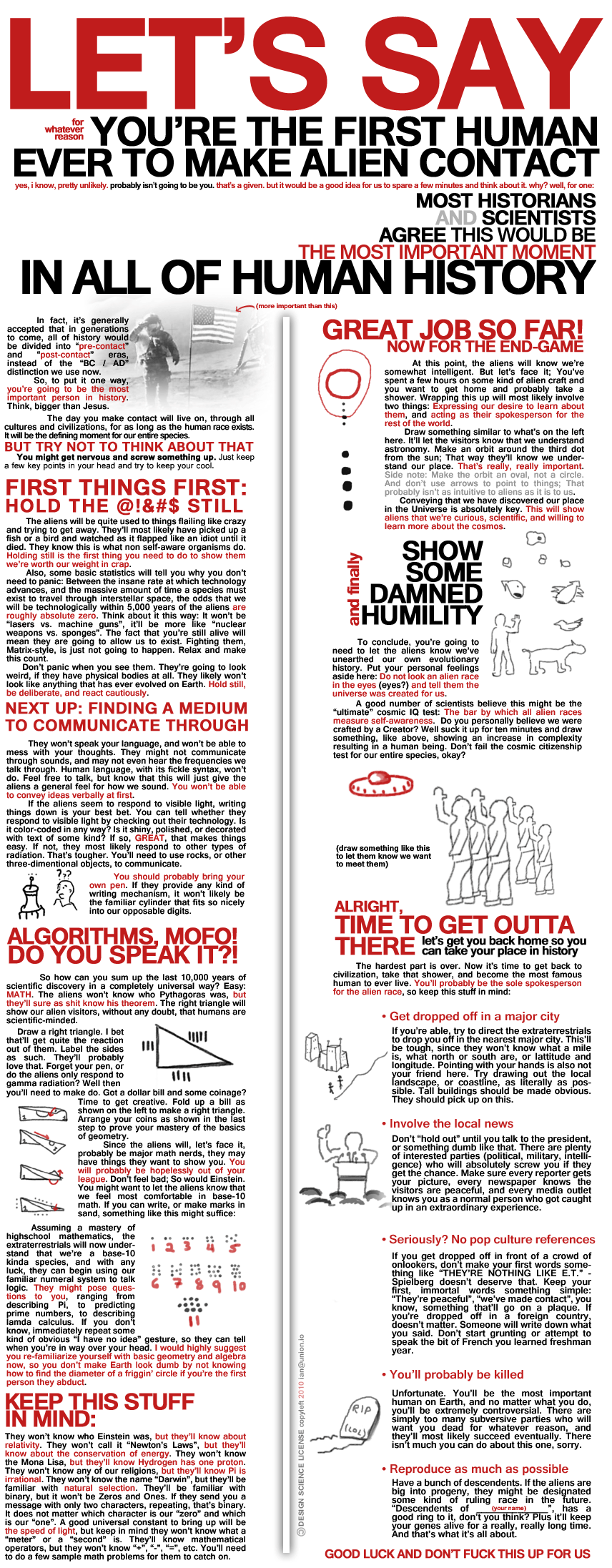
If you ever get abducted by aliens...
Bring a pen, and make sure you learn some basic maths.
Let's say... You're the first human to make contact (large image)
Let's say... You're the first human to make contact (large image)
Monday, May 03, 2010
Wednesday, April 21, 2010
Always train your employees
Sometimes, you assume that people know certain things that are held universally to be true. After all, there is a reason people say "Don't saw off the branch you're sitting on". No?
Well, turns out, it's a fairly common mistake people make.
You see, one must not think that the placement of a ladder is self-evident. There is in fact a lot of technique involved, and pruning must not be left to the untrained and/or inexperienced. For all of you whose initial reaction was a slight chuckle of disbelief, the rest of the article offers further enlightenment as to the course of events.
So as you see, there were actually TWO people involved, and neither of them realized that the ladder was badly positioned. I imagine the exchange between the handyman and the gardener to have gone something along these lines:
Gardener: Hey Pete! Can you help me chop off this branch?
Handyman: Sure thing, Al! Which one?
Gardener: This one right there! Look, I'll set up the ladder for you. That branch right there.
Handyman: You sure you want me to saw off this branch? This doesn't look quite right.
Gardener: Don't worry, Pete, I know what I'm doing! It's perfectly safe. Look, I'll even hold the ladder for you!
Handyman: Well, you are the gardener, after all.
Well, turns out, it's a fairly common mistake people make.
Peter Aspinall, 64, had been asked to prune a sycamore tree in the grounds of a hotel, but instead of leaning his ladder against the trunk he placed it against the branch he was hacking down. [...]
Now Mr Aspinall, who had worked at the Egerton House Hotel near Bolton, Lancashire, for just two weeks, is suing them for compensation. (Source)
You see, one must not think that the placement of a ladder is self-evident. There is in fact a lot of technique involved, and pruning must not be left to the untrained and/or inexperienced. For all of you whose initial reaction was a slight chuckle of disbelief, the rest of the article offers further enlightenment as to the course of events.
[T]he accident happened on July 18, 2008 when Mr Aspinall was helping gardener Alan Ashworth remove the branch because it was shading the lawn.
The men placed their ladder against the branch and Mr Ashworth held the bottom of it while Mr Aspinall climbed up with a bow saw to chop it down.
They did not realise their mistake until the branch finally snapped and Mr Aspinall fell to the ground.
So as you see, there were actually TWO people involved, and neither of them realized that the ladder was badly positioned. I imagine the exchange between the handyman and the gardener to have gone something along these lines:
Gardener: Hey Pete! Can you help me chop off this branch?
Handyman: Sure thing, Al! Which one?
Gardener: This one right there! Look, I'll set up the ladder for you. That branch right there.
Handyman: You sure you want me to saw off this branch? This doesn't look quite right.
Gardener: Don't worry, Pete, I know what I'm doing! It's perfectly safe. Look, I'll even hold the ladder for you!
Handyman: Well, you are the gardener, after all.
Saturday, April 03, 2010
True or not?
The problem with reading stuff on April 1st is that you're never quite sure whether it's real or whether someone is trying to pull a quick one on you.
This post from Tech Dirt is either a well-crafted April Fools, or an example of an increasingly scary trend in the world of business.
This post from Tech Dirt is either a well-crafted April Fools, or an example of an increasingly scary trend in the world of business.
We've been noticing a trend in recent years of companies that sell physical goods trying to figure out ways to have those goods get some of the "advantages" of digital goods. For example, with physical products, once you sell it, in theory, the seller no longer owns a piece of the good. But with digital goods, they still hold the copyright, and often try to limit what you can do with the product even though you thought you "bought" it. So we've been disturbed by the rise of things like artist resale rights, which take away the right of first sale on artwork, and require you to pay the original artist every time you sell the product.
Friday, March 19, 2010
How terms of service are shaping our lives
A while ago, while doing research on a class paper, a sudden realization dawned on me. EULAs and TOSs are the way of the future!
Indeed, TOSs, for instance on websites, govern what you can or cannot do on the website. This considerably modifies people's relationship with content, by transforming a situation that was solely governed by general law into a contractual relationship.
Take the example of television. When you watch at TV show, the only things determining what you can or cannot do with what is broadcasted to you are legal provisions. There is no contract between you and the broadcaster, and the broadcaster can't limit your rights.
But on the Internet, things are different. Surf on any webpage, and there will almost always be TOS. "By accessing this website, you agree..." Now, that same TV show that was broadcasted on the air can be accessed online, but WITH CONDITIONS. All of a sudden, with the sheer power of the Internet, you enter a contractual relationship with the broadcaster, or the owner of the website. Now that there is a contract, the website's owner can effectively determine what actions, albeit otherwise legal, you may or may not take regarding their content.
Take the example of books. Buy a book, and you own it; it's yours forever. Buy an ebook, and you risk having it taken from you anytime.
So, what is so special about the Internet that enables people to impose a contract on you?
Nothing, really.
Internet was just the new medium that enabled people to experiment with new rules. Having TOS on a website would be akin to having a set of rules in a building you enter. Having a TOS or EULA on an ebook you buy is like drafting a contract with a seller every time you buy stuff.
Let us then approach this the other way around. If it is OK to have a EULA on an ebook you have purchased, then wouldn't it also be OK to have a EULA on a plain old dead-tree version of the book? Probably.
And this is where I'm getting at. EULAs and TOS are increasingly shaping our relationship with things around us. More and more people will find that a sales contract is not enough. Companies selling their products will want to retain some form of control over their product, even after having sold it. Control is power. Why then not control it if you can?
I see the future of the consumer-product relationship thus: On one side, consumers will be increasingly subjected to imposed contracts with the manufacturers, distributors, or retailers. These contracts will chalk out the extent of the rights and obligations of the parties, and will become the main source of norms. On the other hand, the corpus of laws will progressively turn into a set of public-policy provisions aimed at striking a balance between the corporations and the consumers.
This post from BoingBoing shows that the trend has already started.
Chinese Take-out Terms of Service
Indeed, TOSs, for instance on websites, govern what you can or cannot do on the website. This considerably modifies people's relationship with content, by transforming a situation that was solely governed by general law into a contractual relationship.
Take the example of television. When you watch at TV show, the only things determining what you can or cannot do with what is broadcasted to you are legal provisions. There is no contract between you and the broadcaster, and the broadcaster can't limit your rights.
But on the Internet, things are different. Surf on any webpage, and there will almost always be TOS. "By accessing this website, you agree..." Now, that same TV show that was broadcasted on the air can be accessed online, but WITH CONDITIONS. All of a sudden, with the sheer power of the Internet, you enter a contractual relationship with the broadcaster, or the owner of the website. Now that there is a contract, the website's owner can effectively determine what actions, albeit otherwise legal, you may or may not take regarding their content.
Take the example of books. Buy a book, and you own it; it's yours forever. Buy an ebook, and you risk having it taken from you anytime.
So, what is so special about the Internet that enables people to impose a contract on you?
Nothing, really.
Internet was just the new medium that enabled people to experiment with new rules. Having TOS on a website would be akin to having a set of rules in a building you enter. Having a TOS or EULA on an ebook you buy is like drafting a contract with a seller every time you buy stuff.
Let us then approach this the other way around. If it is OK to have a EULA on an ebook you have purchased, then wouldn't it also be OK to have a EULA on a plain old dead-tree version of the book? Probably.
And this is where I'm getting at. EULAs and TOS are increasingly shaping our relationship with things around us. More and more people will find that a sales contract is not enough. Companies selling their products will want to retain some form of control over their product, even after having sold it. Control is power. Why then not control it if you can?
I see the future of the consumer-product relationship thus: On one side, consumers will be increasingly subjected to imposed contracts with the manufacturers, distributors, or retailers. These contracts will chalk out the extent of the rights and obligations of the parties, and will become the main source of norms. On the other hand, the corpus of laws will progressively turn into a set of public-policy provisions aimed at striking a balance between the corporations and the consumers.
This post from BoingBoing shows that the trend has already started.
Chinese Take-out Terms of Service
Thursday, January 07, 2010
Son of a Bitch!
In my opinion the words “son of a bitch” by themselves are not capable of any defamatory meaning. They are peculiar, in that they take their meaning either from the tone of voice used or from whatever adjective accompanies them. They are a translucent vessel waiting to be filled with colour by their immediate qualifier. Thus, one has sympathy for a poor son of a bitch, admiration for a brave son of a bitch, affection for a good old son of a bitch, envy for a rich son of a bitch and, perhaps incongruously, dislike for a proper son of a bitch. Why right thinking people should dislike anything that is proper is rather a mystery unless proper is used to mean “real”, but I am confident that is the colour that adjective gives to the expression.Ralston v. Fomich, 1992 CanLII 1652 (BC S.C.)
Saturday, January 02, 2010
Avatar!!
I have finally managed to see the movie Avatar a few days ago. Rounded up a couple of friends, and off we went, and in 3D please.
In short, I found the movie quite amazing.
I have heard some of my friends complaining that the screenplay wasn't that great. However, I have to admit that I was way too busy gawking at the special effects to be bothered by the screenplay. Besides, I didn't find it that bad. Of course, the story was fairly simple and straightforward, with not much in the area of plot twists, or even complicated inter-personal interactions. That's OK, though. I don't mind simple plots. As long as it's consistent with itself, I'm happy. (Other than the fact that they're spending a shitload of munny developing these avatars to interact with the native population when they seem quite happy shooting said natives ded anyway. And that the natives call the Avatars the "Dream-walkers", which sounds like they know that they're remote-controlled, but then Warrior-guy screams bloody murder ("demon in a body!!") when Jake gets pulled from the simulator. And when ...)
All in all, it felt very much like one of those kids' stories, where the forest unites against the evil lumberjacks. You all know what I'm talking about; we've all seen at least 5 versions of the story.
I quite liked the visual effects in the movie. I was amazed at the richness and creativity of the forest's plants and creatures. The 3D effects and animations were also very well done, although I don't really know whether it's worth all the money they spent on it.
There was this one thing that annoyed me a little, though. They made the Blue Cats very hippie-like, with chanting and beaded necklaces, which reflects a certain stereotype of the people who are close to nature. Also, the scientist lady kept emphasizing that what the natives were experiencing was "real", due to the biological-internet nature of the ecosystem, and was something tangible. This somehow validated their experiences, as it proved that they were not just a bunch of tree-hugging lunatics, and, moreover, also made them more worthy of being protected.
I had the feeling that while on one hand, it said "These people have a real, tangible bond with nature, and deserve protection", on the other hand, it made it seem as though the ones who do not have this tangible bond with nature deserve less respect.
In short, I found the movie quite amazing.
I have heard some of my friends complaining that the screenplay wasn't that great. However, I have to admit that I was way too busy gawking at the special effects to be bothered by the screenplay. Besides, I didn't find it that bad. Of course, the story was fairly simple and straightforward, with not much in the area of plot twists, or even complicated inter-personal interactions. That's OK, though. I don't mind simple plots. As long as it's consistent with itself, I'm happy. (Other than the fact that they're spending a shitload of munny developing these avatars to interact with the native population when they seem quite happy shooting said natives ded anyway. And that the natives call the Avatars the "Dream-walkers", which sounds like they know that they're remote-controlled, but then Warrior-guy screams bloody murder ("demon in a body!!") when Jake gets pulled from the simulator. And when ...)
All in all, it felt very much like one of those kids' stories, where the forest unites against the evil lumberjacks. You all know what I'm talking about; we've all seen at least 5 versions of the story.
I quite liked the visual effects in the movie. I was amazed at the richness and creativity of the forest's plants and creatures. The 3D effects and animations were also very well done, although I don't really know whether it's worth all the money they spent on it.
There was this one thing that annoyed me a little, though. They made the Blue Cats very hippie-like, with chanting and beaded necklaces, which reflects a certain stereotype of the people who are close to nature. Also, the scientist lady kept emphasizing that what the natives were experiencing was "real", due to the biological-internet nature of the ecosystem, and was something tangible. This somehow validated their experiences, as it proved that they were not just a bunch of tree-hugging lunatics, and, moreover, also made them more worthy of being protected.
I had the feeling that while on one hand, it said "These people have a real, tangible bond with nature, and deserve protection", on the other hand, it made it seem as though the ones who do not have this tangible bond with nature deserve less respect.
Friday, December 25, 2009
Sunday, November 01, 2009
Karmic Woes
Upgraded to Ubuntu Karmic Koala today. As it always is with new releases, it comes with its own share of quirks that one has to get used to. Some good, some not so good.
Little things that I've noticed:
Ups:
- Firefox seems faster.
Downs:
- the "notification area" is not at the top-right corner, but a bit below that, for no real reason. I've only noticed that for Pidgin notifications, and the area above the notification box is the size of the volume or brightness box.


- another major bummer is the middle-click function that used to work when i clicked on the top right corner of the trackpad. It doesn't work anymore, and there also seems to be a switch in the 2-finger click and 3-finger click functions, which i didn't know existed. The 3-finger click doesn't work on my 'top.
- the new Ubuntu Software Centre. I like the "installed software" section, but i miss being able to install/remove many apps at once.
- having "show icons in menus" unchecked in Appearance Preferences > Interface only removes the icons under the System menu. That's a grand total of 5 icons removed.
- boot time seems much longer, but it might be because it was the first time it was booted after the upgrade.
Undecided:
- Ubuntu is now shipped with a selection of still-life wallpapers, a great number of which feature close-ups of flowers. I hate to admit it, but at some point in my life, I would've gone "ooooooohhhhhh pwetty!" at the sight of it, but now it just seems horribly quaint and bland. To each his own, I guess. I rather liked it when Ubuntu came with 1 default wallpaper. Somehow, it was a symbol of the minimalism of the system. Now it just feels bloated.
There seems to be some typical wallpapers too, besides the close-up flowers: the pier to nowhere, sunrise/sunset, closeup of leaf, &c.
On the upside, I like that they've gotten rid of the fade-in transition when you changed wallpapers, and the black & white clouds pic is quite nice.
- i don't know what's up with the bold text, but I find it rather un-necessary. I figure I'll get used to that eventually. Also, the Firefox shortcut icon on my menu bar seems unusually bright. The blue highlight is paler, it seems, to the previous logo, and it looks like it's shining.

- at the other end of the menu bar, i quite like the icon for the network connection status, but not the one for the messaging services. The Human icon set had a white envelope that earned a green dot at a corner when there was an alert. The new Humanity envelope icon is gray with a dark gray triangle. Not very visible.

(note that the 2 last icons are transparent, and the menu bar is gray.)
Some changes in OpenOffice.org:
- hitting F11 for the Styles dialog will open the dialog, but will not focus it. Rather annoying, because I used to navigate the styles with the arrow keys, and now i have to focus it first.
- they seemed to have fixed that indentation "feature", where hitting backspace would remove the indentation. (Increase the indentation of the paragraph, hit enter. The next paragraph will also be indented. Hit Backspace once, it removes the indentation on the 2nd paragraph. Hit Backspace again, and it will remove the indentation of the previous paragraph, instead of bringing the caret to the indented beginning.)
- that place in the status bar that used to have an "*" signaling unsaved changed now shows a red "!".
Little things that I've noticed:
Ups:
- Firefox seems faster.
Downs:
- the "notification area" is not at the top-right corner, but a bit below that, for no real reason. I've only noticed that for Pidgin notifications, and the area above the notification box is the size of the volume or brightness box.
- another major bummer is the middle-click function that used to work when i clicked on the top right corner of the trackpad. It doesn't work anymore, and there also seems to be a switch in the 2-finger click and 3-finger click functions, which i didn't know existed. The 3-finger click doesn't work on my 'top.
- the new Ubuntu Software Centre. I like the "installed software" section, but i miss being able to install/remove many apps at once.
- having "show icons in menus" unchecked in Appearance Preferences > Interface only removes the icons under the System menu. That's a grand total of 5 icons removed.
- boot time seems much longer, but it might be because it was the first time it was booted after the upgrade.
Undecided:
- Ubuntu is now shipped with a selection of still-life wallpapers, a great number of which feature close-ups of flowers. I hate to admit it, but at some point in my life, I would've gone "ooooooohhhhhh pwetty!" at the sight of it, but now it just seems horribly quaint and bland. To each his own, I guess. I rather liked it when Ubuntu came with 1 default wallpaper. Somehow, it was a symbol of the minimalism of the system. Now it just feels bloated.
There seems to be some typical wallpapers too, besides the close-up flowers: the pier to nowhere, sunrise/sunset, closeup of leaf, &c.
On the upside, I like that they've gotten rid of the fade-in transition when you changed wallpapers, and the black & white clouds pic is quite nice.
- i don't know what's up with the bold text, but I find it rather un-necessary. I figure I'll get used to that eventually. Also, the Firefox shortcut icon on my menu bar seems unusually bright. The blue highlight is paler, it seems, to the previous logo, and it looks like it's shining.
- at the other end of the menu bar, i quite like the icon for the network connection status, but not the one for the messaging services. The Human icon set had a white envelope that earned a green dot at a corner when there was an alert. The new Humanity envelope icon is gray with a dark gray triangle. Not very visible.
(note that the 2 last icons are transparent, and the menu bar is gray.)
Some changes in OpenOffice.org:
- hitting F11 for the Styles dialog will open the dialog, but will not focus it. Rather annoying, because I used to navigate the styles with the arrow keys, and now i have to focus it first.
- they seemed to have fixed that indentation "feature", where hitting backspace would remove the indentation. (Increase the indentation of the paragraph, hit enter. The next paragraph will also be indented. Hit Backspace once, it removes the indentation on the 2nd paragraph. Hit Backspace again, and it will remove the indentation of the previous paragraph, instead of bringing the caret to the indented beginning.)
- that place in the status bar that used to have an "*" signaling unsaved changed now shows a red "!".
Wednesday, October 21, 2009
Movie Review: Law-Abiding Citizen
**ATTN: SPOILERS**
Plotline: Dude get pissed at the way the prosecutor carried out his case, and gets revenge on everybody by blowing them up to bits.
Review: Meh.
To be honest, I don't really know what I was expecting when I decided to go watch this movie. I guess I thought it would be an interesting action movie, and it was mildly related to the justice system, so heck, why not check it out. The trailer made it seem interesting, but then again they always do, and I should've known that. In the end, I have to say, it was rather disappointing.
The trailer set the bar rather high. It was supposed to be a movie about a guy fighting a corrupt system. It was supposed to be a movie about a guy whose intellect was such that he could make people die when he was in prison. It was supposed to be a movie with the typical American patriotism and moral superiority, where good guys prevail and bad guys die.
Well, no.
It turned out to be a movie about a guy who threw a tantrum because he didn't get what he wanted, so everyone else is now the "bad guy" and everybody is personally responsible for what happened to him. The whole plotline was a joke, and only served as a support for a countdown of the 10 most badass ways to kill people.
The Irony started even before the movie. The trailer shown right before the beginning of the film was one of "7 days", in which a father hunts down an tortures the guy who killed his daughter. (Sounds familiar?) The message was clear: this plot is already overused. Then, the high point of that trailer was the dead kid's mom calling the dad, saying "Nobody agrees with what you're doing." And here we are, about to watch a movie celebrating just that.
The nonsenses in this movie are too numerous to be tackled individually. (Why did they have to convict the skinny guy so badly, instead of the fat guy? Why didn't the doctors notice something was wrong when the guy on the execution table was still moving? Did they not notice the steak had a bone?) So I'll just tackle some general issues.
First off, the excuse given for the ire of the dude is quite pathetic. He's angry because the damn prosecutor cut a deal. And this somehow proves that the whole system is corrupt. OK, fine, they tried to show that the prosecutor was very worried by his personal stats, and maybe cared more about his conviction rate than about this elusive concept that we call Justice (with the capital "J" and the band on the eyes). But honestly, prosecutors make deals all the time, and it's not a symptom of corruption per se. Besides, if the prosecutor is only concerned with his own selfish interests, it's not a sign that the whole system is corrupt.
The whole idea was that it is horrible for prosecutors to make deals with criminals, and it would've been better to go to trial and lose, since, at least, the prosecutor would've tried. Well, given the way the story is told, going to trial would probably give the same movie. I'm sure there's lot of films about self-righteous victims who decide to kill jurors because they thought the jurors were corrupt. Either way, the system is supposed to be diseased.
They didn't even make an attempt at including a bit of the corruption that supposedly infects the system. The prosecution was just doing its job, and nothing hits at a job badly done, save the deal. At least they could've tried to show that, I dunno, the prosecution made a mistake and was trying to cover its ass or something. But no. Nothing.
And the judge. Why was the dude so mad at the judge? There was a whole scene at the courthouse that was supposed to show that the judge was incompetent or something, because she was about to release a man charged with murder. Butler's character gave some nice speech that was supposed to sound like bullshit, and cited a precedent that may or may not be real, then accused the judged of being the avatar of the diseased system for being inclined to buy it. Well bad news for you: it's called the Bill of Rights. It's this thing that, ya know, the whole idea of American freedom of democracy is built on.
TBC maybe.
Plotline: Dude get pissed at the way the prosecutor carried out his case, and gets revenge on everybody by blowing them up to bits.
Review: Meh.
To be honest, I don't really know what I was expecting when I decided to go watch this movie. I guess I thought it would be an interesting action movie, and it was mildly related to the justice system, so heck, why not check it out. The trailer made it seem interesting, but then again they always do, and I should've known that. In the end, I have to say, it was rather disappointing.
The trailer set the bar rather high. It was supposed to be a movie about a guy fighting a corrupt system. It was supposed to be a movie about a guy whose intellect was such that he could make people die when he was in prison. It was supposed to be a movie with the typical American patriotism and moral superiority, where good guys prevail and bad guys die.
Well, no.
It turned out to be a movie about a guy who threw a tantrum because he didn't get what he wanted, so everyone else is now the "bad guy" and everybody is personally responsible for what happened to him. The whole plotline was a joke, and only served as a support for a countdown of the 10 most badass ways to kill people.
The Irony started even before the movie. The trailer shown right before the beginning of the film was one of "7 days", in which a father hunts down an tortures the guy who killed his daughter. (Sounds familiar?) The message was clear: this plot is already overused. Then, the high point of that trailer was the dead kid's mom calling the dad, saying "Nobody agrees with what you're doing." And here we are, about to watch a movie celebrating just that.
The nonsenses in this movie are too numerous to be tackled individually. (Why did they have to convict the skinny guy so badly, instead of the fat guy? Why didn't the doctors notice something was wrong when the guy on the execution table was still moving? Did they not notice the steak had a bone?) So I'll just tackle some general issues.
First off, the excuse given for the ire of the dude is quite pathetic. He's angry because the damn prosecutor cut a deal. And this somehow proves that the whole system is corrupt. OK, fine, they tried to show that the prosecutor was very worried by his personal stats, and maybe cared more about his conviction rate than about this elusive concept that we call Justice (with the capital "J" and the band on the eyes). But honestly, prosecutors make deals all the time, and it's not a symptom of corruption per se. Besides, if the prosecutor is only concerned with his own selfish interests, it's not a sign that the whole system is corrupt.
The whole idea was that it is horrible for prosecutors to make deals with criminals, and it would've been better to go to trial and lose, since, at least, the prosecutor would've tried. Well, given the way the story is told, going to trial would probably give the same movie. I'm sure there's lot of films about self-righteous victims who decide to kill jurors because they thought the jurors were corrupt. Either way, the system is supposed to be diseased.
They didn't even make an attempt at including a bit of the corruption that supposedly infects the system. The prosecution was just doing its job, and nothing hits at a job badly done, save the deal. At least they could've tried to show that, I dunno, the prosecution made a mistake and was trying to cover its ass or something. But no. Nothing.
And the judge. Why was the dude so mad at the judge? There was a whole scene at the courthouse that was supposed to show that the judge was incompetent or something, because she was about to release a man charged with murder. Butler's character gave some nice speech that was supposed to sound like bullshit, and cited a precedent that may or may not be real, then accused the judged of being the avatar of the diseased system for being inclined to buy it. Well bad news for you: it's called the Bill of Rights. It's this thing that, ya know, the whole idea of American freedom of democracy is built on.
TBC maybe.
Friday, September 25, 2009
Securities Problem
Last Securities class, the prof gave us a problem to illustrate some principles relating to legal hypothecs, in particular those of "persons having taken part in the construction or renovation of an immovable" (2724 (2) CCQ).
The relevant section of the Civil Code are the following:
- Legal Hypothec (construction) - Bob: 30K
- Legal Hypothec (construction) - Charles: 20K
- Normal Hypothec - ABC Bank: 70K
Legal Hypothecs of constructors are being paid first. However, the owners of the hypothec can only secure the value added to the immovable after the works. The value added corresponds to a percentage of the value of the immovable.
So, the value added was 50K on 150K, which is 33.333%.
This means that the constructors can only secure 33.3% of the proceeds resulting from the sale of the immovable, so 33.333% on 100K, or $33 333.
(1/3 of the value of the building resulted from the works.)
Of the $33 333, 60% goes to Bob, and 40% to Charles. So Bob gets 20K, and Charles gets $13 333.
The rest goes to the Bank.
Now, here's my problem. Both Bob and Charles have a hypothec on the building. However, Charles is a sub-contractor, and the money owed to him is by Bob. This means that of the 30K Bob is owed, 20K was destined to pay Charles. B's "profit" should only have been 10K. However in this case, he gets 20K, which is more than what he's owed! Assuming that C manages to get the ~ 7K he's owed from B, B is still left with ~13K, which is still more than the "profit" he should've earned!
Moreover, A, who only really owes 30K to B, will end up paying >33K!
If you take another situation where the value of the building is high enough that all the creditors will be paid in full. It means that B could get paid 30K, and C would get 20K. So C would have been paid in full, while B, who should have paid 20 of his 30K to C, would be left with an extra 20K.
This does NOT make sense!
Of course, I asked the prof about it, and she replied that it was an "economical question", which somehow should mean that the law has nothing to do with it. She also said that such situations wouldn't matter in practice, because the value of the building wouldn't be enough to pay everybody anyway, and if the building was worth enough, the owner would just sell it himself and pay his creditors.
Very well, So what does it mean? That the legislator writes laws thinking that "Oh, it's OK, there won't be enough money to go around anyway"??
Somehow, I very much doubt that...
The relevant section of the Civil Code are the following:
2726. A legal hypothec in favour of the persons having taken part in the construction or renovation of an immovable may not charge any other immovable. It exists only in favour of the architect, engineer, supplier of materials, workman and contractor or sub-contractor in proportion to the work requested by the owner of the immovable or to the materials or services supplied or prepared by them for the work. It is not necessary to publish a legal hypothec for it to exist.
2728. The hypothec secures the increase in value added to the immovable by the work, materials or services supplied or prepared for the work. However, where those in favour of whom it exists did not themselves enter into a contract with the owner, the hypothec is limited to the work, materials or services supplied after written declaration of the contract to the owner. A workman is not bound to declare his contract.
2952. Legal hypothecs in favour of persons having taken part in the construction or renovation of an immovable are ranked before any other published hypothec, for the increase in value added to the immovable; such hypothecs rank concurrently among themselves, in proportion to the value of each claim.The problem given, which I simplify for the purpose of the present argument, is the following.
Andrew owns a house, valued 100K, on which he does renovations. He has a 75K contract with Bob for the work. Bob sub-contracts with Charles, for work and materials worth 20K. Charles denounces his contract to Andrew. By the end of the works, Andrew still owes 30K to Bob. Charles has not been paid yet. Andrew doesn't pay, so Bob and Charles register a hypothec against Andrew's immovable. Bank ABC also has a 70K hypothec on the same immovable. After the works, the building is worth 150K. The building is sold by judicial authority for 100K. Determine who gets what.So the hypothecs on the building, according to the prof, are as follows:
- Legal Hypothec (construction) - Bob: 30K
- Legal Hypothec (construction) - Charles: 20K
- Normal Hypothec - ABC Bank: 70K
Legal Hypothecs of constructors are being paid first. However, the owners of the hypothec can only secure the value added to the immovable after the works. The value added corresponds to a percentage of the value of the immovable.
So, the value added was 50K on 150K, which is 33.333%.
This means that the constructors can only secure 33.3% of the proceeds resulting from the sale of the immovable, so 33.333% on 100K, or $33 333.
(1/3 of the value of the building resulted from the works.)
Of the $33 333, 60% goes to Bob, and 40% to Charles. So Bob gets 20K, and Charles gets $13 333.
The rest goes to the Bank.
Now, here's my problem. Both Bob and Charles have a hypothec on the building. However, Charles is a sub-contractor, and the money owed to him is by Bob. This means that of the 30K Bob is owed, 20K was destined to pay Charles. B's "profit" should only have been 10K. However in this case, he gets 20K, which is more than what he's owed! Assuming that C manages to get the ~ 7K he's owed from B, B is still left with ~13K, which is still more than the "profit" he should've earned!
Moreover, A, who only really owes 30K to B, will end up paying >33K!
If you take another situation where the value of the building is high enough that all the creditors will be paid in full. It means that B could get paid 30K, and C would get 20K. So C would have been paid in full, while B, who should have paid 20 of his 30K to C, would be left with an extra 20K.
This does NOT make sense!
Of course, I asked the prof about it, and she replied that it was an "economical question", which somehow should mean that the law has nothing to do with it. She also said that such situations wouldn't matter in practice, because the value of the building wouldn't be enough to pay everybody anyway, and if the building was worth enough, the owner would just sell it himself and pay his creditors.
Very well, So what does it mean? That the legislator writes laws thinking that "Oh, it's OK, there won't be enough money to go around anyway"??
Somehow, I very much doubt that...
Sunday, September 06, 2009
What is a Legal Fiction?
Legal fictions are facts or situations assumed or created by courts which are then used to resolve matters before them. Legal fictions are mostly encountered under common law systems. ~ Wikipedia: Legal FictionIn other words, legal fictions are things assumed to be true by the courts, usually to fill a legal or factual void. Legal fictions may or may not be statutory, and are used when the situation fits the criteria set in the statute or in the precedents.
Whats's a Non Sequitur?
Non Sequiturs, as a literary device, is a comment which is humorous as it is unrelated to the previous statement. See Wikipedia
Non Sequiturs in logic are arguments in which the conclusion does not follow from the premises. See Wikipedia again
Tuesday, June 23, 2009
Duty to Represent?
Law is Cool just posted a blog entry about the lawyers' duty to represent even the unpleasant client.
However, I can't say I completely agree with what is being argued in the article. My first reaction is that lawyers are the providers of a service, and as such, should have the freedom to chose who they want to do business with.
On the other hand, the right to justice is one of the most fundamental rights, and everyone should have access to a lawyer to defend these rights. It is very easy to make a parallel between lawyer and doctors, and the natural question to ask is "Should a doctor be allowed to pick and choose his patients, then?" Let's leave this topic for a potential later post, as it is not an easy comparison to make, and besides, it's not particularly relevant for our present purpose.
I think the main problem I have with this is not only with this idea of having a duty to represent someone, but also with the way the problem has been presented.
First off, this idea of duty seems rather strange to me. I understand that a lawyer might have a duty to defend the best interests of his clients, and do so to the best of his abilities. However, I can't really agree with having a duty to take a case just because someone wants you to. I don't think that just because you agree to meet with someone to discuss their case makes makes you obligated to defend them. In short, I don't want to be stuck with such a duty just because someone comes for a consultation.
Then, there's a problem with the way the situation is being presented. See, there are 2 clients: the good one, and the bad one. The Good Client, Good Case, vs the Bad Client, Bad Case. What about the 2 middle ones? What about the Good Client, Bad Case, and the Bad Client, Good Case? Certainly, the goodness of a case is independent from the pleasantness of the client.
However, from the way the question is asked, there is no distinction between a bad client, and a bad case. Such a confusion does little to help solve the ethical problem at hand.
If a client has a bad case, the normal reaction of any lawyer would be to advise him/her against going to court. This has nothing to do with how likeable the client is. But what if the client insists? The above article seems to say that lawyers (at least in Ontario), due to their oath to "neglect no one’s interest and [...] faithfully serve and diligently represent the best interests of [their] client," have a duty to launch a lawsuit and go to court should the client so demand.
I beg to differ. I think that "faithfully serve and diligently represent the best interest of the client" does not equal going to court whenever the client wants to. Indeed, if, as a lawyer, I consider going to court to be against the best interests of the client, either due to the high costs involved, or to any number of valid reasons, then it seems to me that it would be against professional ethics to launch the lawsuit. If I know that a case seems desperate, and that the client is likely to invest a huge amount of time, effort, and money into a lawsuit that s/he will very likely not win, then I would certainly think that it is not in my client's best interest to pursue the matter. If I pledge to serve my client's "best interests", then I don't see how I would have a duty to sue whenever the client asks me to.
This is certainly what happens when a client arrives with a bad case, be it a pleasant client, or an unpleasant one. Correlating bad client and bad case is just oversimplifying the issue. At worst, it is intellectually dishonest, because you then don't separate the consequences of having a bad case, with those of being an unpleasant client, and act as though lawyers who refuse bad cases do so because the clients are unpleasant.
[tbc...]
Imagine two potential civil litigation clients. Both present you with problems well within your expertise and both satisfy your financial retainer requirements. Neither ask you to do anything unethical or underhanded.Prof Morton argues that lawyers have a duty to represent every client, even those who are unpleasant, as every person is entitled to justice. It is hard to find anything to say against that.
The first is a quiet, respectful person who appreciates the limits of the law and wants you to pursue a clearly valid claim. The other is an unpleasant, extreme individual with a warped view of justice and a claim that is marginal.
You explain the law to both clients together with the likely results of litigation. Both ask you to go ahead and issue a claim. What do you do?
However, I can't say I completely agree with what is being argued in the article. My first reaction is that lawyers are the providers of a service, and as such, should have the freedom to chose who they want to do business with.
On the other hand, the right to justice is one of the most fundamental rights, and everyone should have access to a lawyer to defend these rights. It is very easy to make a parallel between lawyer and doctors, and the natural question to ask is "Should a doctor be allowed to pick and choose his patients, then?" Let's leave this topic for a potential later post, as it is not an easy comparison to make, and besides, it's not particularly relevant for our present purpose.
I think the main problem I have with this is not only with this idea of having a duty to represent someone, but also with the way the problem has been presented.
First off, this idea of duty seems rather strange to me. I understand that a lawyer might have a duty to defend the best interests of his clients, and do so to the best of his abilities. However, I can't really agree with having a duty to take a case just because someone wants you to. I don't think that just because you agree to meet with someone to discuss their case makes makes you obligated to defend them. In short, I don't want to be stuck with such a duty just because someone comes for a consultation.
Then, there's a problem with the way the situation is being presented. See, there are 2 clients: the good one, and the bad one. The Good Client, Good Case, vs the Bad Client, Bad Case. What about the 2 middle ones? What about the Good Client, Bad Case, and the Bad Client, Good Case? Certainly, the goodness of a case is independent from the pleasantness of the client.
However, from the way the question is asked, there is no distinction between a bad client, and a bad case. Such a confusion does little to help solve the ethical problem at hand.
If a client has a bad case, the normal reaction of any lawyer would be to advise him/her against going to court. This has nothing to do with how likeable the client is. But what if the client insists? The above article seems to say that lawyers (at least in Ontario), due to their oath to "neglect no one’s interest and [...] faithfully serve and diligently represent the best interests of [their] client," have a duty to launch a lawsuit and go to court should the client so demand.
I beg to differ. I think that "faithfully serve and diligently represent the best interest of the client" does not equal going to court whenever the client wants to. Indeed, if, as a lawyer, I consider going to court to be against the best interests of the client, either due to the high costs involved, or to any number of valid reasons, then it seems to me that it would be against professional ethics to launch the lawsuit. If I know that a case seems desperate, and that the client is likely to invest a huge amount of time, effort, and money into a lawsuit that s/he will very likely not win, then I would certainly think that it is not in my client's best interest to pursue the matter. If I pledge to serve my client's "best interests", then I don't see how I would have a duty to sue whenever the client asks me to.
This is certainly what happens when a client arrives with a bad case, be it a pleasant client, or an unpleasant one. Correlating bad client and bad case is just oversimplifying the issue. At worst, it is intellectually dishonest, because you then don't separate the consequences of having a bad case, with those of being an unpleasant client, and act as though lawyers who refuse bad cases do so because the clients are unpleasant.
[tbc...]
Wednesday, May 27, 2009
Small Claims this week...
St-Pierre v. City of Pohénégamook
from Jugements.qc.ca
First off, yes, it's an actual place, and no, I don't know how to say it either.
For some reason, I seem to be developing a fondness for litigation involving municipalities.
The plaintiff is asking for $6000 worth of damages.
The dispute: August 2008, lots of rain. Inadequate drainage duct contributed to the overflowing of water. The water crossed the road and caused damages to the plaintiff's property.
The water picked itself up, and went "F*** this, I'm crossing the road". Why did the water cross the road? Well, apparently, it seemed to have malicious intentions towards the plaintiff's basement.
The defendant contests, because they weren't expecting that shitload of water to fall on their heads on August 2nd and 3rd.
Proof shows that the City has installed a drainage duct, which had a right-angle bend. The diameter was insufficient. There was an overflow, which damaged the plaintiff's property.
According to the plaintiff, the City was at fault by installing and maintaining the ducts. Moreover, the diameter was inadequate, and the overflow stopped as soon as the duct was removed.
After the events, the City conducted some major work in that area, and rearranged the draining system.
The City argued that the amount of rain received on August 2nd was exceptional (89 mm, vs 33 and 25 for the day before and after). On Aug 2nd and 3rd, the storm drains on Rue Principale overflowed. These drains belong to the Ministry of Transports. The other streets (Pignon and St-Laurent) belong to the City.
Proof has shown that the City has had problems with the drains before, and has replaced some with wider-diameter ones on certain streets. The City knew that the ducts had to be replaced.
JUDGE'S ANALYSIS
Water that caused the damage came from higher grounds, which belongs to the City.
The duct was the cause of the water overflow, which caused damage to the plaintiff's property.
Proof shows that the formation of blockages was highly predictable. The City knew that the diameter was not wide enough.
When a municipality executes work on streets or trenches, they must avoid modification of the natural water flow, or plan an effective drainage system for the water in order to avoid floods.
The defendant has not taken reasonable measures to avoid floods. The City has not acted with prudence and diligence.
The Defendant claims Force Majeure (ss 1470 CCQ), because of the truckload of rain they received. However courts have established that rain, even by the truckload, did not constitute force majeure.
So the lesson is: you should always provide for the deluge.
from Jugements.qc.ca
First off, yes, it's an actual place, and no, I don't know how to say it either.
For some reason, I seem to be developing a fondness for litigation involving municipalities.
The plaintiff is asking for $6000 worth of damages.
The dispute: August 2008, lots of rain. Inadequate drainage duct contributed to the overflowing of water. The water crossed the road and caused damages to the plaintiff's property.
The water picked itself up, and went "F*** this, I'm crossing the road". Why did the water cross the road? Well, apparently, it seemed to have malicious intentions towards the plaintiff's basement.
The defendant contests, because they weren't expecting that shitload of water to fall on their heads on August 2nd and 3rd.
Proof shows that the City has installed a drainage duct, which had a right-angle bend. The diameter was insufficient. There was an overflow, which damaged the plaintiff's property.
According to the plaintiff, the City was at fault by installing and maintaining the ducts. Moreover, the diameter was inadequate, and the overflow stopped as soon as the duct was removed.
After the events, the City conducted some major work in that area, and rearranged the draining system.
The City argued that the amount of rain received on August 2nd was exceptional (89 mm, vs 33 and 25 for the day before and after). On Aug 2nd and 3rd, the storm drains on Rue Principale overflowed. These drains belong to the Ministry of Transports. The other streets (Pignon and St-Laurent) belong to the City.
Proof has shown that the City has had problems with the drains before, and has replaced some with wider-diameter ones on certain streets. The City knew that the ducts had to be replaced.
JUDGE'S ANALYSIS
Water that caused the damage came from higher grounds, which belongs to the City.
The duct was the cause of the water overflow, which caused damage to the plaintiff's property.
Proof shows that the formation of blockages was highly predictable. The City knew that the diameter was not wide enough.
When a municipality executes work on streets or trenches, they must avoid modification of the natural water flow, or plan an effective drainage system for the water in order to avoid floods.
The defendant has not taken reasonable measures to avoid floods. The City has not acted with prudence and diligence.
The Defendant claims Force Majeure (ss 1470 CCQ), because of the truckload of rain they received. However courts have established that rain, even by the truckload, did not constitute force majeure.
So the lesson is: you should always provide for the deluge.
Saturday, May 23, 2009
What happens in the Metro...
I guess I haven't really been following the news lately, because I totally missed what is probably the biggest controversy of the week, namely, the lady getting fined for not holding the handrail in the metro.
My initial reaction upon reading the headlines ("Woman fined for not holding handrail" and the like) was, of course, What The Fuck. But upon reading the article, I have to say that I really can't see anything wrong with what the police did, and I don't particularly sympathize with the lady.
First off, she wasn't only "fined for not holding handrail". Sure, she was. But in my opinion, that fine is only incidental to the real issue, which was obstructing police, for which she got a $320 fine. People shouldn't focus on the handrail, and demonize the police officers because of that. For instance, if the police stops you for a broken headlight, and you assault the police officer because of that, I don't think it would be quite fair to report "Man arrested for broken headlight".
Then, people say that it's stupid to fine people for such a trifle, and the police should have left her off with a warning. However, according to the police, they did warn her multiple times, and he refused to comply. After which they ticketed her. What's a "warning"? No warning would be "Miss, you were not holding the handrail, here's a $100 fine." A warning is: "Miss, you should hold the handrail, please hold the handrail." Or, if you really wanna be thorough with it: "Miss, the law says you have to hold the handrail. You are not holding the handrail. Please hold the handrail (NOW) or you'll get a fine." Here's your warning. So I would say that if you don't start holding that handrail within a reasonably short time, you've had your warning and are eligible for a fine.
Many argue that the police shouldn't be telling people how to ride an escalator. Besides, nobody has ever been fined for not holding the handrail before, so this instance is definitely abusive, right? WRONG. Just because nobody every had doesn't mean nobody ever should be fined, or that it's legally OK not to hold the handrail.
Should she be fined, though? Maybe. I'm not opposed to the fine, and I certainly don't see anything wrong with the fine, given the circumstances.
What circumstances?
Obstructing police work. She yelled at them when they told her to hold the rail.
She says she didn't.
For some reason, I'm not tempted to believe that. Given the facts, I think it's reasonable to say that the police's version is more believable, and that she did obstruct the police in some way.
The only facts we have are these: she was fined for not holding the handrail, and obstruction. She was handcuffed and held in detention.
1. the police was either warning a lot of people, or only picked on her. I find the first case more believable. I don't see any reason the police would pick on her, of all people there.
2. Assuming the police was warning a lot of people, why was she the only one with a fine? Either they picked on her, or she did something to warrant it. Given that she was detained, I'd say she did something. The other option is that police has cuffed her though she didn't do anything. Why would they do that? I don't find this very likely.
So she did something. What did she do?
1. She refused to comply, and
2. Police say she started screaming at them.
Assuming both are true. Should the police have cuffed/arrested her?
(TBC)
My initial reaction upon reading the headlines ("Woman fined for not holding handrail" and the like) was, of course, What The Fuck. But upon reading the article, I have to say that I really can't see anything wrong with what the police did, and I don't particularly sympathize with the lady.
First off, she wasn't only "fined for not holding handrail". Sure, she was. But in my opinion, that fine is only incidental to the real issue, which was obstructing police, for which she got a $320 fine. People shouldn't focus on the handrail, and demonize the police officers because of that. For instance, if the police stops you for a broken headlight, and you assault the police officer because of that, I don't think it would be quite fair to report "Man arrested for broken headlight".
Then, people say that it's stupid to fine people for such a trifle, and the police should have left her off with a warning. However, according to the police, they did warn her multiple times, and he refused to comply. After which they ticketed her. What's a "warning"? No warning would be "Miss, you were not holding the handrail, here's a $100 fine." A warning is: "Miss, you should hold the handrail, please hold the handrail." Or, if you really wanna be thorough with it: "Miss, the law says you have to hold the handrail. You are not holding the handrail. Please hold the handrail (NOW) or you'll get a fine." Here's your warning. So I would say that if you don't start holding that handrail within a reasonably short time, you've had your warning and are eligible for a fine.
Many argue that the police shouldn't be telling people how to ride an escalator. Besides, nobody has ever been fined for not holding the handrail before, so this instance is definitely abusive, right? WRONG. Just because nobody every had doesn't mean nobody ever should be fined, or that it's legally OK not to hold the handrail.
Should she be fined, though? Maybe. I'm not opposed to the fine, and I certainly don't see anything wrong with the fine, given the circumstances.
What circumstances?
Obstructing police work. She yelled at them when they told her to hold the rail.
She says she didn't.
For some reason, I'm not tempted to believe that. Given the facts, I think it's reasonable to say that the police's version is more believable, and that she did obstruct the police in some way.
The only facts we have are these: she was fined for not holding the handrail, and obstruction. She was handcuffed and held in detention.
1. the police was either warning a lot of people, or only picked on her. I find the first case more believable. I don't see any reason the police would pick on her, of all people there.
2. Assuming the police was warning a lot of people, why was she the only one with a fine? Either they picked on her, or she did something to warrant it. Given that she was detained, I'd say she did something. The other option is that police has cuffed her though she didn't do anything. Why would they do that? I don't find this very likely.
So she did something. What did she do?
1. She refused to comply, and
2. Police say she started screaming at them.
Assuming both are true. Should the police have cuffed/arrested her?
(TBC)
Wednesday, May 20, 2009
In small claims court...
Ever since I went to visit the Small Claims Court back in January, I found a liking to these little cases. Granted, it's not Judge Judy, and reading a case is not as fun as watching the proceedings, but they nevertheless offer a glimpse into the issues of ordinary people. Had a bit of time today, so I decided to look up some of the latest cases. I just picked one that seemed interesting: Gaudreault c. Future Shop, because everyone knows Future Shop, and I wanted to see what the Gaudreault person had against the store.
Note: below is a summary of the decision, and not a complete translation.
This case is quite typical, as lack of proof is one of the main reasons a claim gets dismissed. I can imagine such things can be quite frustrating. One one side, it's one of these lawsuits that happen when you do something you shouldn't. Bad things happen, and you want someone to pay for it. The guy shows up with a car that's too small, squeeze a valuable and potentially fragile article inside. It breaks, and the guy is trying to blame the store.
On the other hand, there's a guy who just spent a substantial amount of money getting a big TV, and doesn't even get to use it once. He hasn't been able to enjoy his TV, so of course he feels that the money has been wasted, and wants it back.
Well, apparently that's not gonna happen.
So the moral of the story is this: before you even start wondering whether you're right or wrong, make sure you can PROVE IT. And a busted TV doesn't prove anything.
Note: below is a summary of the decision, and not a complete translation.
Gaudreault v. Future Shop
Qc, Ca, Chicoutimi District
Judge: Jean-Yves Tremblay
The plaintiff demands the replacement of a 52-inch Samsung LNT TV, bought May 31, 2008, because the empolyee of the defandant has accidentally knocked the TV while loading the furniture (TV table?), thereby breaking it.
[Declaration of Gaudreault's wife, stating that the Future Shop employee was loading the TV with her husband]
[Contestation from the defendant, stating that the plaintiff was informed his car was too small, and was warned that the plaintiff would be responsible for any damages, but decided to transport the TV nevertheless. Physical damages are not covered by the Service Plan. The defendant also claims that it is impossible to determine when the damage has occurred, and the plaintiff has been warned of the risks.]
[Declaration of and employee of the defendant, stating that the TV has been wrapped in bubble wrap and then loaded in the plaintiff's car. The employee had remarked that the car was very small to transport a TV of that size.]
Proof revealed that the TV was very well wrapped. The plaintiff had also been offered the delivery service and the employees had warned the plaintiff the risks.
The Plaintiff's wife was in the car, and confirmed the loading maneuvers, but couldn't confirm that it was then the TV was broken. Moreover, the Plaintiff was part of the maneuvers, and even if that was when the damages occurred, he is the first to affirm that it was an accident.
Article 2803 states that "A person wishing to assert a right shall prove the facts on which his claim is based."
[...]
In the current case, it is impossible to determine when the damages occurred. Was it during the loading, the transport, the unloading, or the installation? Moreover, the Plaintiff had participated in the operations.
(Source: Jugements.qc.ca)
This case is quite typical, as lack of proof is one of the main reasons a claim gets dismissed. I can imagine such things can be quite frustrating. One one side, it's one of these lawsuits that happen when you do something you shouldn't. Bad things happen, and you want someone to pay for it. The guy shows up with a car that's too small, squeeze a valuable and potentially fragile article inside. It breaks, and the guy is trying to blame the store.
On the other hand, there's a guy who just spent a substantial amount of money getting a big TV, and doesn't even get to use it once. He hasn't been able to enjoy his TV, so of course he feels that the money has been wasted, and wants it back.
Well, apparently that's not gonna happen.
So the moral of the story is this: before you even start wondering whether you're right or wrong, make sure you can PROVE IT. And a busted TV doesn't prove anything.
Tuesday, May 19, 2009
Chinese, English, & Probabilities
I just discovered a Chinese-learning blog that looked very interesting. I read a few entries, and came up across a post about some phonetic coincidences between English words and their Chinese translation.
This is a very interesting topic, as it has some kind of mystical appeal. However, every time someone wonders whether something is just a coincidence or not, I have a strong urge to work out the math behind it, and find out exactly what the odds are. So I have done a bit of number crunching. Here goes:
According to this table: Wikipedia Pinyin Table Chinese words have a possibility of 402 different sounds (I counted). That's not including the intonations, since I'm assuming that "fee" (in English), for instance, would be deemed similar to "fei" whether it's the 1st tone or the 4th. This means that any Chinese word would have to match one of these 402 sounds.
Assuming that every english word has a corresponding chinese word, and that every english sound has a corresponding sound in Chinese that can be deemed "close enough", it means that given a random English word, and a random Chinese sound, there are 1 in 402 chances that the meaning of a chinese word matching that sound corresponds to the same definition in English.
Therefore, for every English word, there is a 1/402 chance that its Chinese equivalent has the same sound. (assuming every Chinese sound can correspond to an English one. )
If we then assume (conservative estimate) that there are 3500 single-syllable words in English (Dr. Phyllis Fisher's word list) and every word having a 1 in 402 chance of finding its correspondent in Chinese, then the odds would be that 3500 X 1/402 = 8.7 English words would sound similar in chinese.
The odds would be even more favourable if you decide that sounds like zh/z, ch/c, sh/s, an/en, ang/eng ai/ei, etc. are similar enough to be considered identical, and if you assume there are more one-syllable English words.
This is a very interesting topic, as it has some kind of mystical appeal. However, every time someone wonders whether something is just a coincidence or not, I have a strong urge to work out the math behind it, and find out exactly what the odds are. So I have done a bit of number crunching. Here goes:
According to this table: Wikipedia Pinyin Table Chinese words have a possibility of 402 different sounds (I counted). That's not including the intonations, since I'm assuming that "fee" (in English), for instance, would be deemed similar to "fei" whether it's the 1st tone or the 4th. This means that any Chinese word would have to match one of these 402 sounds.
Assuming that every english word has a corresponding chinese word, and that every english sound has a corresponding sound in Chinese that can be deemed "close enough", it means that given a random English word, and a random Chinese sound, there are 1 in 402 chances that the meaning of a chinese word matching that sound corresponds to the same definition in English.
Therefore, for every English word, there is a 1/402 chance that its Chinese equivalent has the same sound. (assuming every Chinese sound can correspond to an English one. )
If we then assume (conservative estimate) that there are 3500 single-syllable words in English (Dr. Phyllis Fisher's word list) and every word having a 1 in 402 chance of finding its correspondent in Chinese, then the odds would be that 3500 X 1/402 = 8.7 English words would sound similar in chinese.
The odds would be even more favourable if you decide that sounds like zh/z, ch/c, sh/s, an/en, ang/eng ai/ei, etc. are similar enough to be considered identical, and if you assume there are more one-syllable English words.
Tuesday, April 14, 2009
Just answering some fan mail
Hey JC, I have been listening to The Mystery of the Yellow Room. Just what is your background? Your English diction is great - and from the other comments I take it that your French is equally perfect. But I can't place your accent.Hi MaryAnn! Thank you so much for your kind comments! I'm glad to see that you are enjoying the audiobooks.
Whatever, you are an excellent reader and I am truly enjoying The Yellow Room.
MaryAnn (who has been a lawyer now for some 15+ years, is still enjoying the profession while hopefully making a positive contribution to society at large, and who wishes you a long and satisfying career)
I'm actually of Chinese origin, so Mandarin is technically my first language. I've been living in Quebec for quite a while, so my French definitely has a Quebec accent. I guess my English would be Canadian English with a bit of Quebecois background.
However, since I tend to mumble a bit when I talk, I try to enunciate more, and one of the ways I've found was to borrow a bit of british-ish pronounciation, like saying "oll" for "all". Which might make the accent a bit erratic at times, and I do apologize for the listeners who are annoyed by that.
I hope this answers your question!
Thanks again for your comments!
PS: I'm glad that you are still enjoying the legal profession! :)
Subscribe to:
Posts (Atom)